
01
Enter your fare
Type the fare shown in the app or on the taxi meter. The calculator works out the tip on the exact fare, so the number is ready before the rating screen closes.
Rideshare tipping guide
Tip 15 to 20% on Uber and Lyft rides, and 10% is fine on a short basic ride. Tip more for long rides, airport runs, luggage, and bad weather. Enter your fare below, pick a rate, and the calculator shows the tip and the total at once. On a $25 ride, a 20% tip is $5.
Your tip, total, and per-person share, updated as you type.
Tip 15 to 20% of the fare for good service, and 10% is fine on a short basic ride with no extras. On a $25 ride, 20% is $5 and 15% is $3.75. The same rate covers Lyft and taxis. Tip more when the ride is long, the weather is bad, or the driver helps with bags.
Uber and Lyft use the same tipping rule, so you do not need a new rule for each app. The Uber driver tipping guide covers airport runs, luggage, and cash tips, and the Uber vs Lyft comparison shows how in-app tipping works on each app.
For food delivery instead of a ride, the delivery tip calculator uses the same 15 to 20% range with a $4 to $5 minimum on small orders.

A good Uber tip is 20% of the fare, or 15% for a standard ride with no extras. Ten percent is fine on a short basic ride. On a $40 fare, 20% is $8 and 15% is $6. Tip more for airport runs, luggage, and bad weather. Use the calculator above to work out the tip on your own fare.
Enter the fare, pick 15% to 20%, and set the tip in the app or hand the driver cash. The calculator shows the tip amount and the ride total at once. On a short basic ride, 10% is fine, so pick the rate that fits the ride you just took.
Type the fare shown in the app or on the taxi meter. The calculator works out the tip on the exact fare, so the number is ready before the rating screen closes.
Tap 20% for good service or 15% for a standard ride. On a short basic ride with no extras, 10% is fine. You can also type any custom percentage you want.
Add the tip in the app after the ride, or hand the driver cash. Either way works. The calculator shows the tip and the total at once, so the number is ready when the app asks.
On a $40 fare, the tip is $4 at 10%, $6 at 15%, and $8 at 20%. The table shows all three rates on fares from $10 to $85. Use the 10% column only for short basic rides with no extras. For most rides, the 15% and 20% columns give the fair tip.
| Fare | 10% tip | 15% tip | 20% tip |
|---|---|---|---|
| $10.00 | $1.00 | $1.50 | $2.00 |
| $15.00 | $1.50 | $2.25 | $3.00 |
| $25.00 | $2.50 | $3.75 | $5.00 |
| $40.00 | $4.00 | $6.00 | $8.00 |
| $60.00 | $6.00 | $9.00 | $12.00 |
| $85.00 | $8.50 | $12.75 | $17.00 |
Ten percent is fine on short basic rides only. Tip 15 to 20% on most rides, and more for long rides and bad weather.
A $24 fare at 20% gives a $4.80 tip, so the ride total with the tip is $28.80. At 15%, the tip is $3.60 and the total is $27.60. The steps below show the same math the calculator runs, from the fare to the final tip, so you can check each number yourself.
Tip Amount = Fare × Tip Percentage
Total With Tip = Fare + Tip Amount
For example: $24 × 0.20 = $4.80 tip. $24 + $4.80 = $28.80 total with tip.
On a short $8 ride, 10% is $0.80. Round it up to $1. A tip under a dollar reads as an afterthought, and the round number is easy to set in the app.
On a long $60 airport ride, 20% is $12. That is the right tip when the driver waits in airport traffic and loads your bags.
The rates
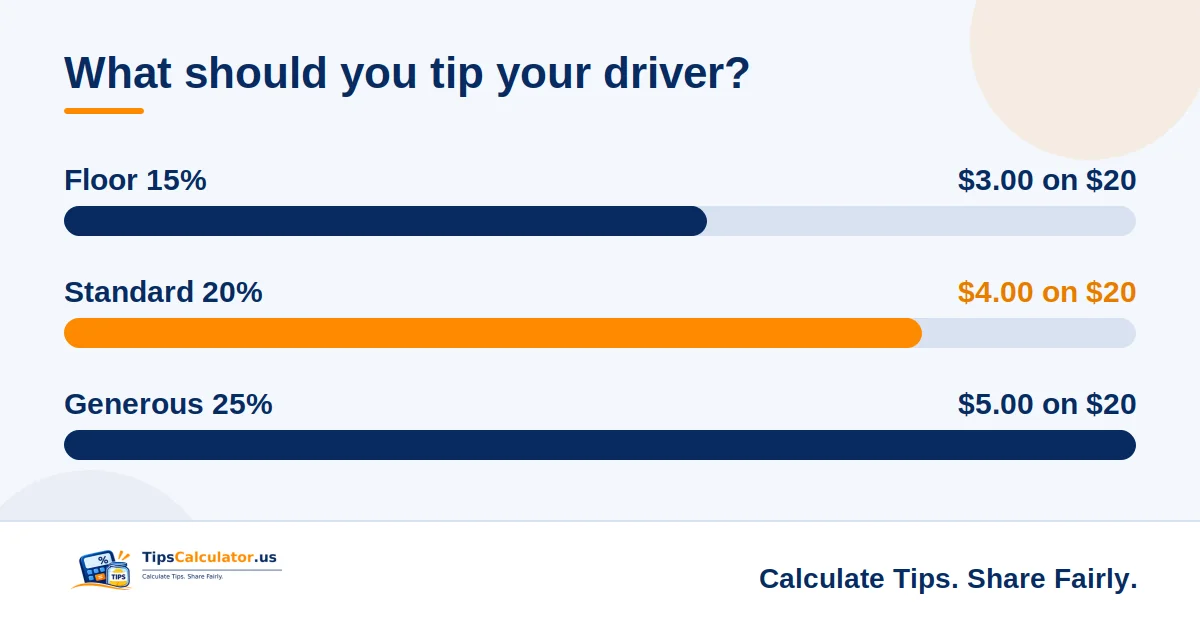
Tip 15% to 20% of the fare for a standard Uber or Lyft ride. Twenty percent is the standard for a clean, safe, on-time trip. Fifteen percent covers a short ride done right, and 25% is generous for airport runs, heavy luggage, or a driver who waited. Tip on the fare, not on tolls or fees.
A short ride done right. On a $20 fare, 15% is $3.
Clean, safe, on time. On a $20 fare, 20% is $4. This is the rate most riders use.
Airport runs, heavy luggage, waiting time, late nights. On a $20 fare, 25% is $5.
The fare you see is not the driver's pay. Uber and Lyft take their share of the fare, and the driver covers gas, insurance, and car wear from what is left. The tip goes to the driver in full on both apps, which makes it the most direct part of what you pay. A $4 tip on a $20 ride is small money to you and real money to the driver.
What changes it
Luggage, extra stops, waiting time, the hour of the trip, and the ride type all change the tip. A 2 a.m. airport run with two suitcases is not the same trip as a ten-minute daytime ride, and the tip should show the difference.
Bags earn a dollar or two each when the driver loads them. Two checked bags on an airport run add $2 to $3.
Each stop adds time and miles. Tip up when the trip has more than one drop-off.
A driver who waited at the curb earned the top tier. Waiting is unpaid time in most fare math.
Tip on the fare you paid. Surge raises the fare, and the tip follows the fare. Fifteen percent of a surge fare is still a fair tip.
UberXL and Black cost more, so the same percentage tips more. Shared rides tip on your fare, not the whole car.
A clean car and smooth driving earn the top tier. A rough ride earns the floor, and a safety issue earns a report, not a tip cut.
The data
Yes, on both major apps. Uber states that drivers keep 100% of tips with zero service fees taken from them, and riders can add a tip up to 30 days after the trip. Lyft states the same: drivers keep 100% of tips, always.
Of Uber tips go to the driver. Uber states it takes zero service fees from tips.
Of Lyft tips go to the driver. Lyft states drivers keep 100% of tips, always.
The 30-day window means a forgotten tip is never lost. Open the trip receipt in the app, add the tip, and the driver gets it in full. Cash works too, and it reaches the driver at once instead of in the next payout. In-app tips are easier to track, and they show up in the driver's earnings summary with the trip they belong to.
Sources: Uber, How to Tip Your Driver; Lyft, Driver Pay.
Tricky situations
Four situations cause most of the confusion with rideshare: Uber's no-tipping past, surge fare sticker shock, a long route, and shared rides where nobody knows who tips. Each has a simple answer, and the rule behind all four is the same: tip the trip you took, on the fare you paid, and let the app's support page handle the rest.
Early Uber had no tipping, and the habit stuck for some riders. In-app tipping is now built into both Uber and Lyft, and drivers expect it like taxi drivers always have. Tip the ride.
Tip on the fare you paid. A surge fare is the fare, and 15% of it is a fair tip. Dropping to zero because the fare was high punishes the driver for the app's pricing.
Dispute the fare in the app and tip on the corrected fare. A bad route is a support issue. Cutting the whole tip over a route the app chose is not.
Each rider tips on their own fare. On Uber, a tip added by the person who booked the ride is not split with the other passengers, so the booker tips for the booking, and everyone else tips their own share.
Worked example
A $42 airport fare with $6 in tolls costs $48 before the tip. Tip 20% on the $42 fare, which is $8.40, and the total is $56.40. Two checked bags earn another $2 to $3, which brings the trip to about $59. The tolls stay out of the tip math.
$42 × 0.20 = $8.40 tip at 20% on the fare
$42 + $6 tolls + $8.40 = $56.40 total
$56.40 + $2 to $3 for two bags = about $59
At 15%, the tip is $6.30 and the total before bags is $54.30. At 25%, the tip is $10.50 and the total is $58.50.
Rideshare tipping questions usually cover the right percentage, short rides, cash tips, and whether Uber, Lyft, and taxis share one rule. The answers below give the standard rate for each case with real dollar amounts. For delivery and hotel rates, the calculators on the hub page cover each service on its own.
Tip 15 to 20% of the fare for good service. On a $25 ride, 20% is $5. Tip more for long rides, airport runs, help with luggage, or bad weather. The same rate covers Lyft and taxis, so one rule works for every ride. Add the tip in the app after the ride, or hand the driver cash.
Yes, 10% is fine on a short, basic ride with no extras. A short hop with no bags and no wait does not ask much of the driver, so 10% is a fair tip. On longer rides, or rides with luggage, airport runs, or bad weather, use 15 to 20% instead. When in doubt, round up to the next dollar.
Both work, and the driver gets the tip either way. In-app tipping is the easy choice: the app asks for a tip after the ride, so you never need cash on hand. Cash works too, and some drivers like it because it is in hand. Pick the option you will use, since a tip you skip helps no one.
Yes. The same 15 to 20% rule covers Uber, Lyft, and taxis, and 10% is fine on a short basic ride. On Uber and Lyft, the app asks for a tip after the ride and lets you pick a preset or type an amount. Ignore a low preset when the ride was good, and tip what the service was worth.
The delivery calculator covers food orders, and the hotel calculator covers stays. See all tip calculators on the calculators hub when you need a different tool.
Free, no sign-up
Use the Uber tip calculator above to get the exact tip and total in seconds. Enter the fare, pick 20% for good service, and tip 10% only on short basic rides. It is free, it needs no sign-up, and it shows the math so you can tip with confidence.
 Add as a preferred source on Google