
01
Enter your order total
Type the order total from the app or the receipt. Use the food total before fees so the percentage is figured on the order itself.
Delivery tipping guide
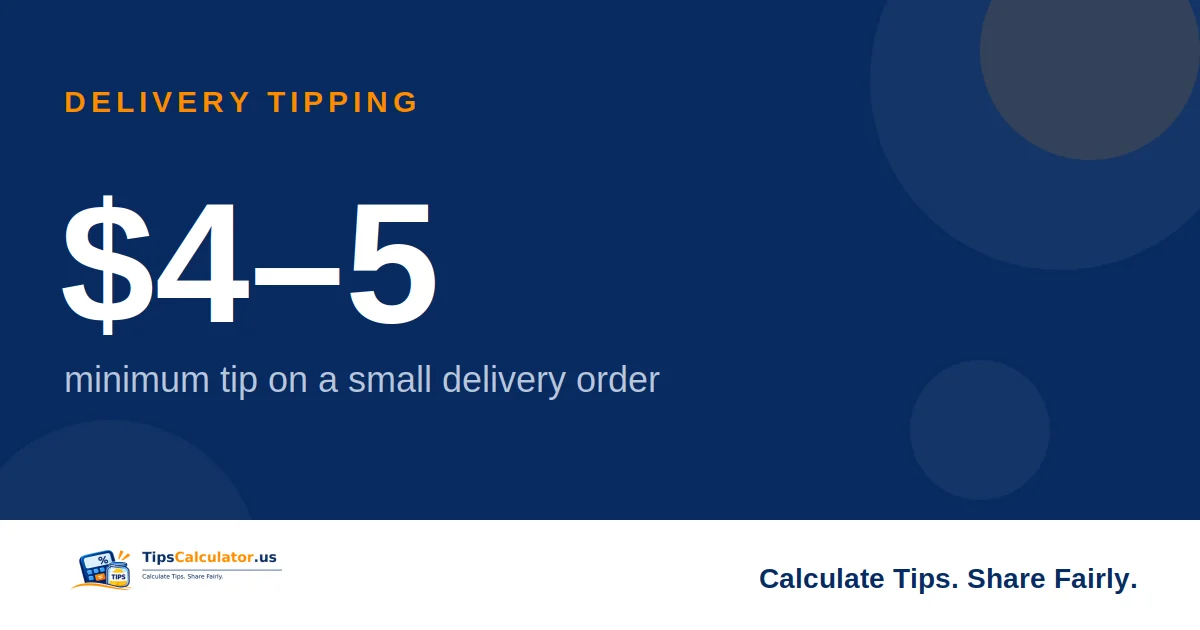
Tip 15 to 20% on food delivery, with a $4 to $5 minimum on small orders. That rule covers DoorDash, Uber Eats, and grocery delivery, while pizza delivery uses a $3 to $5 minimum. Enter your order total below, pick a rate, and the calculator shows the tip and the total at once. On a $30 order, a 20% tip is $6.
Your tip, total, and per-person share, updated as you type.
Tip 15 to 20% of the order total, with a $4 to $5 minimum on small orders. The minimum matters most: on a $12 order, 20% is only $2.40, so $4 to $5 is the fair tip for the trip. Pizza delivery uses a $3 to $5 minimum, then 15 to 20% on bigger orders.
DoorDash and Uber Eats orders follow the same rule. The DoorDash tipping guide covers the minimum rule in full, and the pizza delivery guide covers pizza and grocery orders. For rides instead of food, the Uber and Lyft tip calculator uses the same 15 to 20% range.
Add a few dollars when the trip is hard: bad weather, stairs, or a long drive from the restaurant. The driver still makes the same trip, and the extra tip is what makes a hard delivery worth taking.
A good delivery tip is 20% of the order total, or $4 to $5 on a small order, whichever is higher. Fifteen percent is the low end for a basic on-time delivery. On a $40 order, 20% is $8 and 15% is $6. Use the calculator above to work out the tip on your own order total.
Enter the order total, pick 15% to 20%, and check the result against the $4 to $5 minimum on small orders. The calculator shows the tip amount and the order total at once. Use the food total before fees, so the percentage is figured on the order itself and not on the delivery fee.
Type the order total from the app or the receipt. Use the food total before fees so the percentage is figured on the order itself.
Tap 20% for good service or 15% for a basic on-time drop-off. On a small order, check the result against the $4 to $5 minimum and use the higher number.
Add a few dollars for bad weather, stairs, or a long drive. The calculator shows the tip and the total at once, so you can set the tip in the app with confidence.
On a $100 order, the tip is $15 at 15% and $20 at 20%. The table shows both rates on orders from $10 to $100. On the two smallest orders, the $4 to $5 minimum beats the percentage, so the last column shows the tip to leave. For any other order total, the calculator above gives the exact tip in seconds.
| Order total | 15% tip | 20% tip | Tip to leave |
|---|---|---|---|
| $10.00 | $1.50 | $2.00 | $4 to $5 |
| $15.00 | $2.25 | $3.00 | $4 to $5 |
| $25.00 | $3.75 | $5.00 | $5.00 |
| $40.00 | $6.00 | $8.00 | $6 to $8 |
| $60.00 | $9.00 | $12.00 | $9 to $12 |
| $100.00 | $15.00 | $20.00 | $15 to $20 |
On orders under $25, the $4 to $5 minimum is the fair tip. Tips are figured on the food total before fees.
A $32 DoorDash order at 20% gives a $6.40 tip, so the order total with the tip is $38.40. At 15%, the tip is $4.80 and the total is $36.80. The steps below show the same math the calculator runs, from the order total to the final tip, so you can check each number yourself.
Tip Amount = Order Total × Tip Percentage
Total With Tip = Order Total + Tip Amount
For example: $32 × 0.20 = $6.40 tip. $32 + $6.40 = $38.40 total with tip.
Now try a small order. A $12 order at 20% gives a $2.40 tip, which is below the $4 to $5 minimum. Leave $5 instead. The driver makes the same trip for a $12 order as for a $32 order, and the minimum is what makes the small trip worth taking.
For a pizza order, the same math holds with a $3 to $5 floor. A $20 pizza order at 20% is $4, which sits inside the minimum range, so $4 is the right tip.
The rates
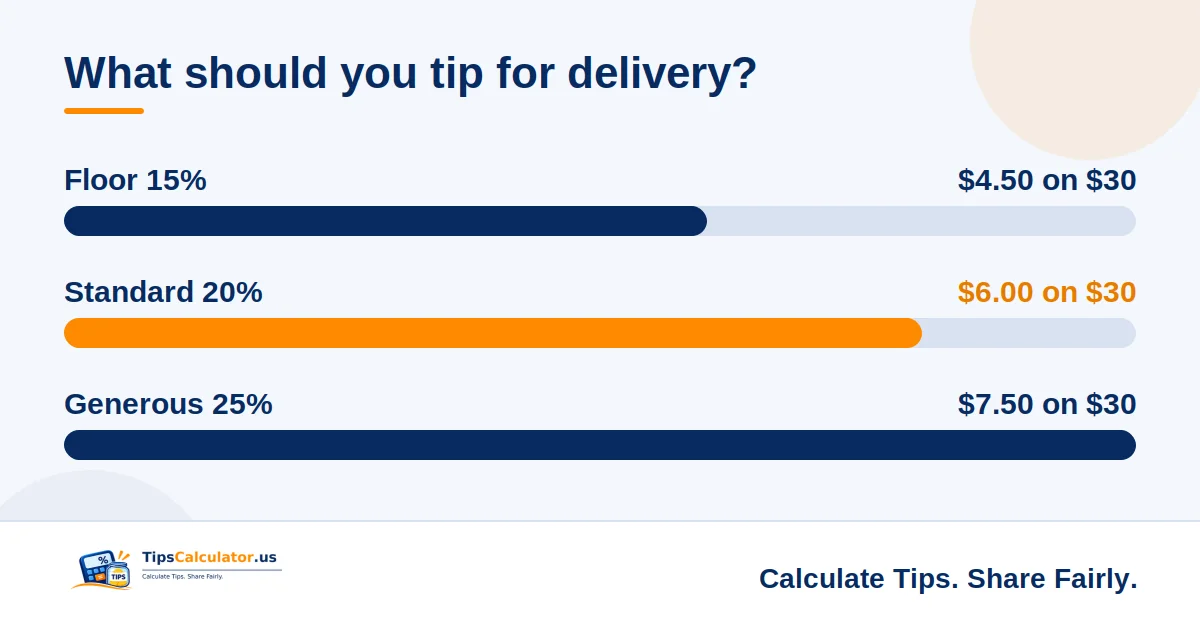
Tip 15% to 20% of the food subtotal for delivery, with a $4 to $5 minimum on small orders. A $12 lunch at 20% is only $2.40, which does not cover the drive, so the floor matters more than the percentage on small orders. Long drives, bad weather, and big orders all push the tip up.
Close, easy, fair weather. On a $30 order, 15% is $4.50. Never below $4 to $5, even on tiny orders.
The normal rate for a normal trip. On a $30 order, 20% is $6. This is the rate most regulars use.
Rain, snow, stairs, or a long drive. On a $30 order, 25% is $7.50. Hard trips earn the top tier.
The delivery fee is not the tip. The fee goes to the platform or the restaurant, and the driver never sees it as income. Tip on the food subtotal, before fees and tax. When the app shows a suggested tip, check the math against the food subtotal. The suggestion is a starting point, not a rule.
What changes it
Distance, weather, order size, stairs and access, and how fast you need it all change the tip. A driver covers gas, car wear, and time on every order, and the tip is the part of the pay that reflects the trip you asked for.
A 10-mile run costs the driver more time and gas than a 2-mile run. Tip up for distance, and tip up again when the route is slow.
Rain, snow, and extreme heat all earn the top tier. The driver is out in it so you do not have to be.
Large orders and grocery runs tip by effort. Heavy bags, many items, and catering trays all push the tip up.
Stairs, gated entries, and office buildings add time. Add $2 to $3 when the driver has to hunt for you.
Priority and rush orders ask the driver to go now. A faster trip earns a bigger tip.
DoorDash and Uber Eats both pass 100% of tips to the driver. The tip you enter is the tip the driver gets, in full.
The data
Yes. DoorDash states that Dashers receive 100% of customer tips on top of base pay and promotions, and that base pay does not change with the tip amount. Uber states the same for Uber Eats: 100% of tips go to the courier, with no service fees taken from tips.
Of DoorDash tips go to the Dasher, on top of base pay and promotions. Base pay does not move with the tip.
Of Uber Eats tips go to the courier. Uber states it takes zero service fees from tips.
That matters because the tip is the only part of delivery pay you control directly. Base pay is set by the platform. Promotions come and go. The tip you enter is the one number that goes to the driver in full, and on DoorDash it is added after the delivery on top of everything else. Uber Eats gives customers one hour after delivery to change a tip, so a tip added in a hurry can still be fixed.
Cash still works. A cash tip reaches the driver at the door with no wait and no app record. In-app tips are easier to track and can be added after the delivery on DoorDash. Either way, the driver keeps the full amount. What hurts is a low tip on a long trip, because Dashers see the offer amount, tip included, before they accept, and a low-paying order waits.
Tricky situations
Four situations cause most of the confusion with delivery: the fee that looks like a tip, the tip lowered after delivery, a late order, and a grocery run that is really three trips in one. Each has a simple answer.
It is not. The delivery fee, the service fee, and the small-order fee all go to the platform or the restaurant. Only the tip line goes to the driver. Read the checkout screen line by line before you pay.
Lowering a tip because the food was cold punishes the driver for the restaurant's kitchen. Tip the trip, and review the restaurant separately. The driver did not cook the food.
Late from the restaurant is not the driver's fault. Late because the driver took three other orders first is a different story, and the app's support page is the place for it, not the tip line.
Tip on effort. A grocery run with forty items, heavy bags, and three flights of stairs is not a $4 trip. Tip 20% or more, and add for the stairs.
Worked example
A $38 pizza order travels four miles in the rain. Twenty-five percent is $9.50, so the food plus tip is $47.50 before the delivery fee and tax. The $3.99 delivery fee stays separate: it is not part of the tip and does not go to the driver as a tip.
$38 × 0.25 = $9.50 tip at 25%
$38 + $9.50 = $47.50 food plus tip
Delivery fee $3.99 stays separate, and is not part of the tip
At 20%, the tip is $7.60 and the food plus tip is $45.60. On a clear day and a short drive, that is the right call. Rain and distance earned the extra $1.90.
Delivery tipping questions usually cover the right percentage, the minimum on small orders, pizza rules, and where the delivery fee goes. The answers below give the standard rate for each case with real dollar amounts. For rideshare and restaurant rates, the calculators on the hub page cover each service on its own.
Tip 15 to 20% of your order total, with a $4 to $5 minimum on small orders. On a $30 order, 20% is $6. On a $12 order, 20% is only $2.40, so the $4 to $5 minimum gives the driver a fair payment for the trip. Add more for bad weather, stairs, or a long drive.
Use a $4 to $5 minimum on small orders when 15 to 20% gives a smaller number. A $10 order at 20% is a $2 tip, which does not cover the driver's time, gas, and trip to your door. The minimum keeps small orders worth the drive. On larger orders, the percentage takes over and the minimum no longer applies.
Tip $3 to $5 at a minimum for pizza delivery, and 15 to 20% on bigger orders. On a $20 pizza order, 20% is $4, which sits inside the minimum range. On a $50 order, 20% is $10, so the percentage is the right tip. Add a few dollars for bad weather or a long drive from the shop.
Usually not. The delivery fee and the service fee go mostly to the app or the restaurant, not to the driver. Your tip is separate, and it is the part of the payment that reaches the driver for the trip. That is why the tip matters even when the fees on the order already look high.
The Uber calculator covers rides, and the restaurant calculator covers table service. See all tip calculators on the calculators hub when you need a different tool.
Free, no sign-up
Use the delivery tip calculator above to get the exact tip and total in seconds. Enter the order total, pick 20% for good service, and check the $4 to $5 minimum on small orders. It is free, it needs no sign-up, and it shows the math so you can tip with confidence.
 Add as a preferred source on Google